

Who is at your Thanksgiving table?
Media depictions of Thanksgiving tend to look the same — one family, gathered around a traditional dining room table, a large roasted turkey surrounded by sides in the center. It’s the Normal Rockwell Thanksgiving. But how accurate is it today? Does it reflect what your Thanksgiving table will look like? And why does this scene still resonate with so many today...or does it?
Consider:
About one in six Thanksgiving celebrations won’t include a turkey at all (Butterball), while 65% of Gen Z would rather the meal feature just the sides anyway. (Campbell’s)
For some people, it’s all about Friendsgiving: 21% of people have attended or plan to attend a Friendsgiving this year, while 38% of Gen Z say the same thing. (Civic Science)
The size of celebrations is pretty evenly split, with a third of people saying they will celebrate Thanksgiving with just immediate family, 31% saying it will be an even smaller group than usual, and 29% saying it will be a big group (meanwhile, 7% are taking the opportunity to go on vacation or do something different). (Civic Science)
A lot of our preconceived notions about how people live may not hold up anymore, whether it’s our ideas about generations or the types of images we picture when we think about celebrations, dinners, households, families, jobs, etc.
That’s one of the things we’ve been researching as we are working on our upcoming 2027 Trends & Drivers report. We’ll share more when it’s ready next month. But, in the meantime, we hope you have a good Thanksgiving, whatever your table looks like.
Maeve, Mike, Erin, and Shelley
DID YOU KNOW?
70% of people agree that quality is becoming a luxury people can’t afford.
This June we asked 1,000 U.S. adults how food prices are changing what they buy. Seven in ten agreed that quality is becoming a luxury most people can’t afford. And many are acting on it. 36% said they’d switched from a name brand to a store brand in the past three months because of food prices. And in our 2026 Consumer Needs survey, 63% said they’d pick the more affordable product over a locally sourced one that costs more.
So as the holiday season kicks off, value will probably be on a lot of shoppers’ minds. Thanksgiving alone will cost 6.3% more than it did last year. But value doesn’t always mean the lowest price. Often it means showing people what they’re getting for their money: a scratch-made sauce, a better ingredient, a portion that feels generous.
This fall Cheerios teamed up with Ziploc to offer an innovation that people have been clamoring for: a resealable bag. At a time when it feels like everyone else is cutting products down to the bone, Cheerios is giving their customers something an extra, a change with a real benefit.
How can you make quality within reach of more customers and not an unattainable luxury available to only a small subset?
For more on this topic, check out episode 15 of The Mess Hall, the Menu Matters podcast.
Can anyone define ultra-processed?
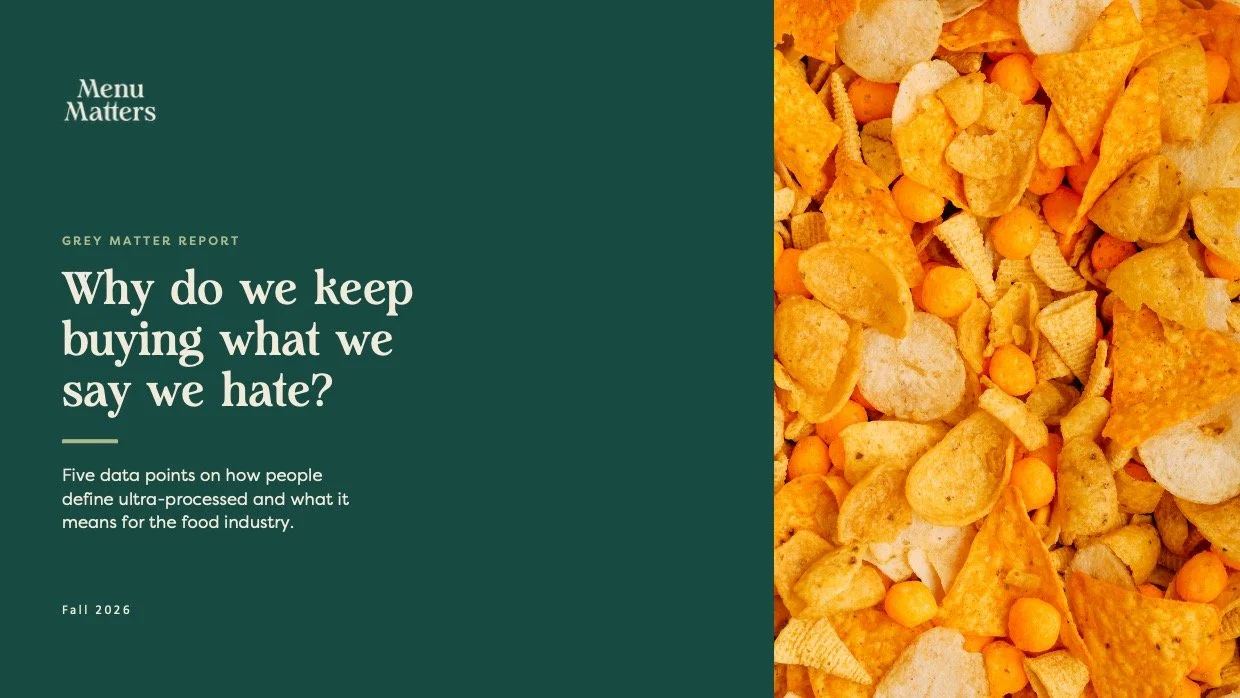
“Ultra-processed” is everywhere right now: in headlines, on social media, in state legislatures, and on the front of some packages. California just created a “Non-Ultraprocessed Certified” seal.
But when we asked people what the term actually means, the answers were all over the place:
66% say added preservatives make a food ultra-processed. Only 38% say “made in a factory” counts, even though that’s closer to how many researchers define it.
26% couldn’t explain what it means in their own words. Among Gen Z, it’s 38%.
12% of Gen Z call an apple ultra-processed, compared to less than 1% of Boomers+.
Our latest Grey Matter Report boils the research down to five data points, with ideas for operators, manufacturers, commodity boards and suppliers for each one.
What We Learned
On LinkedIn, we start the week with our #MondaySparks (three creative ideas to jumpstart the week) and end the week with our #FridayFive (five things we learned in the past week). Here are five of the most popular posts from the past month:
3 million people in the UK say every plate and fork they own is stolen.
What fall can teach us about letting things end beautifully.
You can catch every #FridayFive, #MondaySparks, and more here and here.
The Hot List
Delicious meals, excellent hotels, favorite products, thought-provoking books, great TV shows and movies — these are some of Maeve and Mike’s favorite recent discoveries.

Big Picture Farm Caramels
“When Menu Matters first started sending holiday gifts, and for several years after that first time, we sent out Big Picture Farm caramels. This Vermont-based company uses their own goat milk to create a line of caramels that feature flavors as familiar as vanilla and sea salt to less familiar like cider honey, raspberry rhubarb and wild chocolate mint. To this day, we still get comments about them and have referred countless people to this brand. They also sell homemade chocolates and, of course, goat cheese. If you're looking for a gift for colleagues, friends or family, you won't be disappointed." MAEVE
“If you know Maeve and I, you know we love ‘forest flavors’ — spruce, fir, juniper, smoky woods, etc. So when I heard about Sauna Water, I knew I had to order it. It’s a splurge to have canned water shipped to you, but it was worth it — I think I’m addicted now. The Nordic Spruce flavor (spruce tip, cardamom, juniper, and lemon) is my favorite, but the Superior Coast (lime, sage, hyssop, elderflower, and juniper) is also delicious. It’s a refreshing, wintery beverage for any seltzer water fans in your life looking for something different. And it makes a great gin and ‘tonic,’ to boot. (For what it’s worth, Forest Water’s ‘Alpine Soda’ is also tasty, though a bit heavy on the citrus.)” MIKE
“Another fantastic sweets brand is Germany's Zotter Chocolates. They have the range of traditional chocolate bars you would expect, but they also offer what they call ‘hand scooped’ chocolates. These may sound like truffles but they are extra thick chocolate bars which, we learned while in Munich, are meant to be sliced like cheese rather than eaten like a candy bar. This brand is incredibly innovative with its flavors which include yuzu citrus, orange caramel coconut, mango chili, lime & passionfruit and mulled wine. These are the perfect special and indulgent treat.” MAEVE
“I don’t think I’ve thought about, referenced, or recommended a non-fiction book more this year than Cory Doctorow’s ‘Enshittification,' which looks at the slow degradation of so many products and experiences. I thought about it again the other day when I opened up a piece of tech I bought in Germany and was shocked to find that it included all 12 AAA batteries you needed. Every other company would have put that expense on the customer a long time ago. And I think about it whenever I open a food container that has a plastic seal on top but doesn’t even have the little tab to pull it off anymore, an attempt at saving a few pennies. It’s a great stocking stuffer for the type of person who wants to get worked up about the state of the world.” MIKE
Where We’ll Be
New York, NY – December 4 – New York Produce Show Ideation Fresh Foodservice Forum
Verona, NY – January 5 – SASU Conference, Turning Stone Resort
Youngstown, OH - Steelite Trends Connect – January 12–15
Chicago, IL – January 28 – Taste the Trends with the Chicagoland Food & Beverage Network
Scottsdale, AZ – February 2–4 – Private Client Event
Chicago, IL – March 18–21 – LDEI Annual Conference
Dallas, TX – March 23–25 – Research Chefs Association Annual Conference
Are restaurants too loud?
Why does it take so many years to bring a new fruit or vegetable to market? And why does flavor so often rank behind shipping durability, yield, and disease resistance? Maeve and Mike talk with Jill Overdorf, The Produce Ambassador, and Jenny Maloney of Bayer Crop Science Vegetable Seeds about how climate change and AI are changing plant breeding, the push and pull between foodservice and retail, and why some produce is turning into a luxury item. Plus, stick around for their food industry pet peeves.
Want to keep the produce conversation going? Join us and Jill at the Ideation Fresh Foodservice Forum in New York on December 4.
You can find it on all of your favorite podcast platforms (Apple, Spotify, Amazon, Overcast), and at Heritage Radio Network.
Bring our 2027 drivers to your team.
Our 2027 Trends & Drivers are coming together now: one main driver for the year and five sub-drivers, built on our own nationally representative research, with what each one means for people and for the industry.
Before your team locks its 2027 plans, we can walk you through them in a presentation or a working session, along with the trends we think matter most for your category. Bring the trend lists your team has been collecting, too. We’ll help sort out which ones apply to your business, and which ones probably don’t.
